

Puppy fear periods are temporary developmental windows during which a previously confident puppy suddenly develops fearful reactions to familiar people, objects, or situations. Puppies experience their first fear period at 8–11 weeks, and the second fear period occurs between 6–14 months. These phases are a developmentally normal part of canine growth-not signs that something is wrong with your dog.
This guide covers how to recognize signs of fear, understand the timing and duration of each fear period, apply professional management techniques, and know when to seek professional guidance. It does not replace veterinary intervention for severe behavioral disorders or anxiety conditions that persist well beyond normal developmental windows. If you’re a puppy owner in the New River & Roanoke Valleys watching your generally playful new puppy cower at a plastic bag blowing across the yard or freeze at the sight of a vacuum cleaner, this resource is for you.
The direct answer: Fear periods are a normal evolutionary part of puppy development-temporary 2–3 week phases where your dog’s brain undergoes rapid maturation, causing sudden caution toward stimuli that were previously no big deal. Puppies typically go through two distinct primary fear imprint periods, and with proper handling, these windows pass without a lasting impact on your adult dog’s temperament.
By the end of this guide, you will:
- Recognize common symptoms and fearful body language indicating a fear period
- Understand exactly when fear periods occur and how long they last
- Learn the CALM Method for managing fear responses through positive reinforcement
- Know when a fear response crosses from a normal stage into territory requiring professional help
- Build a foundation for long-term confidence that carries through your dog’s life
Understanding Puppy Fear Periods
Fear periods are evolutionarily programmed developmental windows during which puppies undergo significant mental and emotional development phases. They are not random behavioral glitches. During these windows, a puppy’s nervous system temporarily heightens its sensitivity to novel or unfamiliar stimuli, making the puppy more cautious, vigilant, and prone to anxiety. Fear periods are common in the first 1–2 years of life, and they serve a clear biological purpose: preparing a young dog for independence and self-sufficiency.
The Neurological Basis
The key to understanding puppy fear lies in the dog’s brain development. During fear periods, critical structures-the amygdala (threat detection), hippocampus (contextual memory), and prefrontal cortex (emotional regulation)-are undergoing rapid reorganization. Synaptogenesis, neural pruning, and shifts in connectivity change how stimuli are perceived and processed. Before these structures mature, puppies show blunted fear responses because the circuits simply aren’t online yet.
As sensory systems sharpen-vision, hearing, and coordination all improve-puppies become more aware of subtle environmental cues they previously couldn’t detect. A harmless object like a trash can or an umbrella suddenly registers as something worth evaluating. Cognitive changes compound this: the puppy shifts from pure positive curiosity toward cautious risk assessment. Stress hormones like cortisol begin playing a larger role in activating fear responses once certain maturity thresholds are crossed. This is why your puppy experiences what looks like a personality reversal-the same puppies who charged fearlessly toward strangers last week now retreat behind your legs.
Evolutionary Purpose
Fear periods are a normal evolutionary mechanism, not a flaw. As puppies develop greater independence and range, increased caution protects them from genuine dangers. In wild canids, a puppy that approaches every unfamiliar animal or situation with reckless confidence wouldn’t survive long. These critical time windows allow puppies to refine threat detection and learn which stimuli warrant avoidance.
This evolutionary lens matters for practical reasons: it tells us that fighting against your puppy’s fear during these windows is working against biology. The goal isn’t to eliminate the fear response but to guide it-ensuring your puppy learns that most novel stimuli are safe while maintaining healthy caution. Understanding this biological foundation makes the specific timing patterns far more intuitive.
When Fear Periods Occur and Their Characteristics
With the neurological foundation established, the natural question becomes: when exactly do fear periods occur, and what should you expect to see? While most dogs generally experience two fear periods, the exact timing, intensity, and duration vary based on breed, genetics, and prior experience.
First Fear Period (8–11 Weeks)
The first fear period typically begins around 8 weeks of age, though some puppies show signs as early as 7 weeks. This timing is significant because it coincides exactly with when most puppies leave their litter and join a new family. According to Purdue University’s Canine Welfare Science documentation, this period overlaps with the tail end of the primary socialization window (3–14 weeks of age).
Common triggers during this first fear period include novel surfaces, strange noises, new people (especially men or people wearing hats and sunglasses), unfamiliar objects, and handling they previously tolerated. During fear periods, puppies may react fearfully to everyday objects or situations-a puppy who happily rode in the car last Tuesday may suddenly tremble and refuse to jump in. Signs of a fear period include cowering, avoidance, and vocalizing.
Fear periods typically last 2–3 weeks at this age. Because early socialization is still actively shaping the puppy’s baseline comfort, recovery tends to be faster when exposures are handled with care. This is a critical period for building positive associations that will serve your puppy throughout its life.
Second Fear Period (6–14 Months)
The second fear period occurs between 6–14 months, aligned with adolescence and sexual maturation. The broad window exists because breed size dramatically affects timing: small breed dogs may experience fear periods earlier than large breeds, sometimes as young as 6 months, while giant breeds may not enter this phase until 12–14 months.
Behavioral manifestations during the second period tend to be more complex than in the first. You may see fear-based reactivity toward other dogs, sudden-onset territorial behavior, increased sensitivity to noise, social withdrawal, or separation anxiety. Physically mature but emotionally developing adolescent dogs often display confusing contradictions-boldness in one context, panic in another. Hormonal surges during this period may amplify anxiety and lower the threshold for stress responses.
Fear periods last approximately 2–3 weeks in puppies during this adolescent window as well, though dogs with limited prior socialization may experience protracted or repeated fear responses. Some owners report what appear to be multiple mini-fear periods within this broader developmental phase, particularly in large or giant breeds.
Individual Variations
It’s important to recognize that not all dogs experience fear periods with the same intensity or even at the same time. Breed-specific tendencies play a significant role: toy breeds mature faster physically but may retain higher baseline sensitivity, while large breeds mature slowly and may have delayed adolescent fear windows. Genetic predisposition matters too-lines bred for confidence versus those from more fearful backgrounds will show different patterns.
Well-socialized puppies who received rich, positive early socialization across many environments, people, and other animals tend to show milder or less disruptive fear periods. Some puppies show minimal or no obvious signs at all. Conversely, a single traumatic event during a fear period can create a possibly long lasting fear-overwhelming experiences can imprint lasting fears in puppies. This individual variation is precisely why management strategies need to be adaptable.

Professional Management Strategies During Fear Periods
Knowing when fear periods occur is valuable, but knowing what to do during them is essential. The following strategies are grounded in behavioral science and align with AAHA’s behavior management guidelines for puppies in sensitive developmental windows.
The CALM Method for Fear Period Training
Use this systematic approach whenever your puppy displays fear responses during a developmental fear window. Keep each training session short and fun for your puppy-overwhelming a fearful dog with marathon sessions backfires.
- Create safe distance from fear triggers. Identify the threshold where your puppy’s body language shifts from alert to afraid, and stay beyond it. Allow your puppy to control their distance from scary things. If your puppy panics near other dogs at the park, move farther away rather than pushing closer.
- Allow observation without pressure. Let your puppy watch the trigger from a comfortable distance. Give your puppy time to process what it sees. No luring, no dragging, no forcing-just calm observation. This facilitates habituation without flooding.
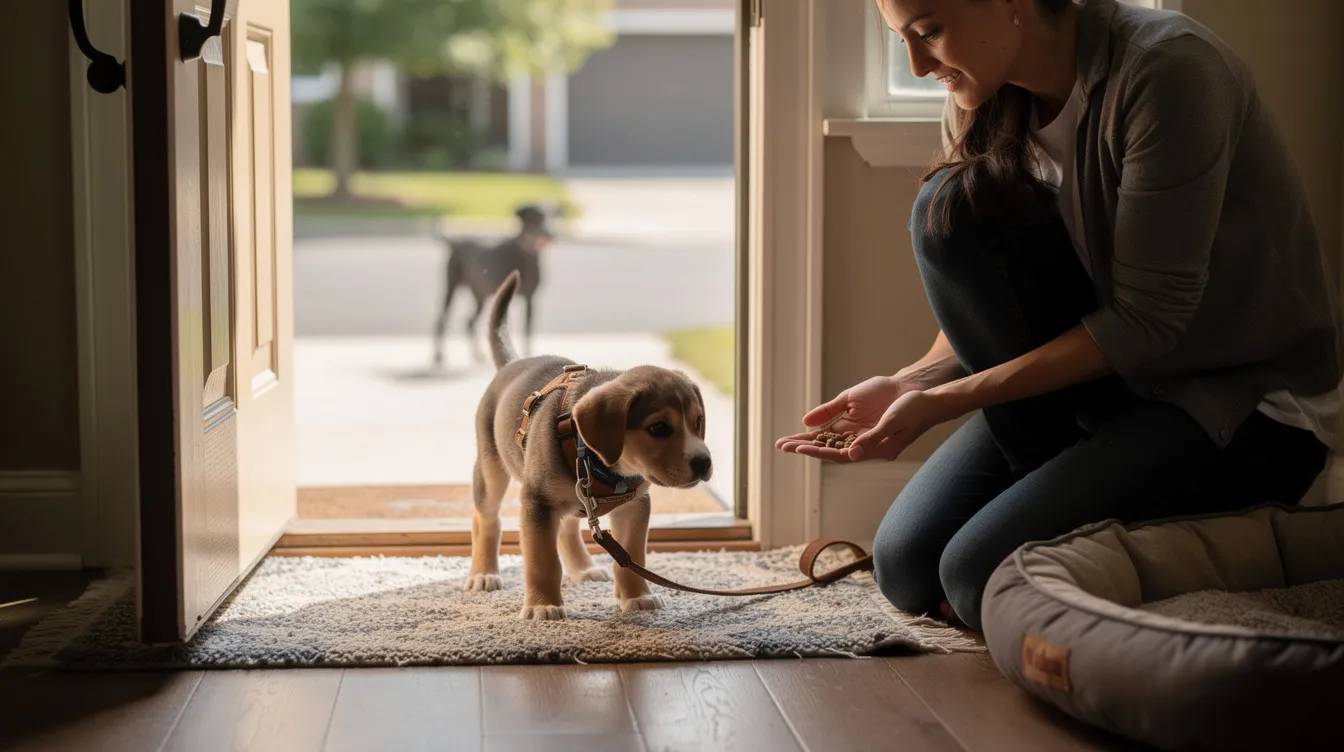
- Look for and reward calm behavior. The moment your puppy shows relaxed body language, curiosity, or even neutral acknowledgment of the trigger, mark it. Praise and reward your puppy for exploring scary objects. Pairing fearful stimuli with high-value treats can help create positive associations. This is positive reinforcement training at its most effective.
- Maintain positive associations through gradual, controlled exposure. Slowly decrease distance or increase intensity only after your puppy consistently shows calm responses at the current level. Socialization during fear periods should focus on low-stress exposure. Never rush this progression-your training goal is to create situations where success is inevitable.
Do’s vs. Don’ts Comparison
| Criterion | Effective Response (Do) | Counterproductive Response (Don’t) |
|---|---|---|
| Fearful behavior | Stay calm and remain neutral; puppies read human emotions closely, and remaining calm helps them feel safe | React with frustration, anxiety, or excessive coddling that reinforces the scary situation |
| Exposure approach | Keep exposures short, positive, and below threshold; let the puppy set the pace | Force the puppy to confront triggers (dragging toward strangers, pushing into cars) |
| Training methods | Use positive reinforcement-treats, praise, play-to build a positive association | Apply physical corrections, leash pops, scolding, or punishment for fearful reactions |
| Trigger management | Maintain safe distance and allow the puppy control over approach/retreat | Flood the puppy with an overwhelming amount of stimuli at once |
| Routine | During fear periods, maintain a consistent routine to provide psychological safety | Introduce multiple major changes (new environment, new people, new schedule) simultaneously |
| Owner mindset | Treat this as a positive learning opportunity and a normal part of development | Assume the puppy will “just grow out of it” without any guidance |
Avoid negative experiences during your puppy’s fear period. Do not punish fearful behavior; positive reinforcement is recommended. Negative experiences during fear periods can lead to long-term behavior issues that affect your dog’s behavior well into adulthood. Avoid forcing exposure to fearful stimuli during a fear period-this single principle prevents the majority of fear-period mistakes.
With these strategies in place, most puppies navigate fear periods smoothly. But some situations require more targeted problem-solving.
Common Challenges and Solutions
Even with the same understanding of fear periods and solid technique, specific scenarios can catch puppy owners off guard. Here are the most common difficulties and their evidence-based solutions.
Puppy Suddenly Fears Previously Enjoyed Activities
Your puppy was completely comfortable with car rides, loved the dog park, or played happily with a specific toy-and now refuses. During fear periods, puppies become more sensitive to new stimuli, and even familiar experiences can suddenly register as threatening.
Solution: Reduce intensity immediately. For car fear, start by feeding treats in the parked car without driving. For a toy, place it nearby without demanding interaction. For locations, visit at quieter times with shorter durations. Reintroduce gradually and let your puppy approach on its own terms. A smart puppy given agency recovers faster than one forced into compliance. Never make it a big deal-your relaxed demeanor signals safety.
Fear Responses Intensifying Despite Proper Management
Sometimes a fear response escalates despite your best efforts. You see whale eye, trembling, refusal to eat, or emerging reactivity toward other dogs or people. When fear generalizes across multiple stimuli or intensifies over time, the situation may exceed what standard management can address.
Solution: Professional help may be needed for severe or persistent fear in puppies. A veterinary behaviorist can rule out underlying medical issues-pain, sensory decline, or neurological problems-that mimic or amplify fear-related responses. Behavior modification services may include structured desensitization hierarchies, counter-conditioning protocols, or, in severe cases, pharmacological support. If you’re in the Roanoke or Blacksburg area, our team at Off Leash K9 Training can evaluate whether your puppy’s responses fall within normal developmental ranges or require more intensive intervention.
Distinguishing Fear Periods from Developing Behavioral Issues
The critical distinction: normal fear periods in dogs are temporary (2–3 weeks), situational (triggered by specific stimuli), and occur during expected developmental windows. If fearful behavior persists beyond 3–4 weeks, generalizes to many situations, produces escalating aggression, or significantly interferes with daily life, it may signal an emerging anxiety disorder or phobia rather than a standard developmental phase.
Timeline indicators for seeking professional intervention:
- Fear persists beyond the expected 2–3 week window with no improvement
- Dog’s behavior worsens despite consistent, positive management
- Fear responses appear outside known developmental windows
- The puppy shows sudden onset aggression when previously only showing avoidance
- Quality of life declines-refusing food, eliminating indoors, inability to walk outside
Early professional guidance during a fear period can prevent what starts as a normal stage from crystallizing into a chronic issue. Future training sessions become significantly harder when fear has had months to entrench.
Conclusion and Next Steps
Puppy fear periods are not emergencies-they are a developmentally normal part of your dog’s life that, with proper guidance, pass without lasting harm. Puppies undergo significant mental and emotional development phases, and the temporary caution you see at 8–11 weeks of age or during the 6–14 month adolescent window is your puppy’s brain doing exactly what evolution designed it to do. The difference between a fear period that resolves cleanly and one that leaves a lasting impact comes down to how you respond.
Your immediate action steps:
- Document what triggers your puppy’s fear responses-specific objects, people, sounds, and contexts
- Implement the CALM Method consistently, keeping each training session short and reward-heavy
- Maintain your daily routine and remain calm during fearful episodes
- Monitor the timeline: if responses persist beyond 3 weeks or intensify, contact a professional
Related topics worth exploring: structured puppy foundational training during developmental phases, advanced socialization techniques for adolescent dogs, and building long-term obedience through board and train programs designed for emotionally developing puppies.
Additional Resources
Off Leash K9 Training New River & Roanoke Valleys offers free phone consultations for puppy owners navigating fear periods and other developmental challenges. Our puppy foundational programs and behavior modification services are specifically designed to support puppies through critical developmental windows using positive reinforcement and fear-free care principles.
To schedule an appointment at our Roanoke or Blacksburg locations, or to learn more about our plans and pricing, visit our website or call for a consultation. Early enrollment in a structured training class during your puppy’s socialization window gives both you and your dog the strongest foundation for lifelong confidence.