
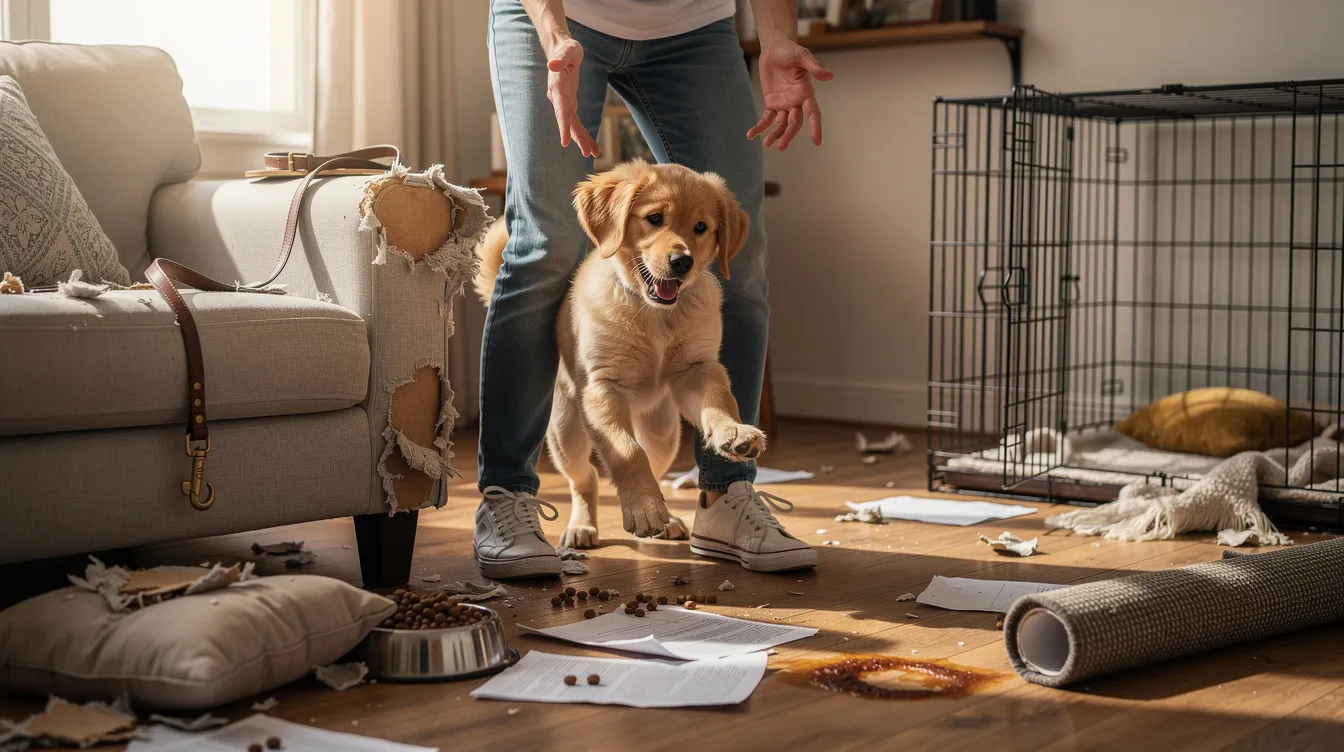
Most puppy training mistakes happen in the first few months-and many dog owners don’t realize the damage until their pup is an anxious, reactive adult. The gap between what new owners expect and what puppies actually need is where lasting behavioral problems take root. Whether it’s inconsistent commands, skipping socialization, or accidentally rewarding bad behavior, these common dog training mistakes create patterns that become exponentially harder to fix over time.
This article covers the most damaging training mistakes made during the first 16 weeks of a puppy’s life, drawing on veterinary behavioral science and what professional trainers see repeatedly in their practice. It’s written for new puppy owners in Virginia who want to prevent costly behavioral problems and set their furry friend up for lifelong success. Advanced topics like e-collar conditioning or therapy dog preparation fall outside the scope here-this is about getting the foundation right.
The biggest puppy training mistakes include inconsistent commands across family members, expecting instant results from training sessions, skipping early socialization before 16 weeks, and accidentally reinforcing unwanted behavior with attention. Training should start immediately when bringing a puppy home, and the methods you choose in those early weeks shape the rest of your dog’s life.
Here’s what you’ll gain from reading this:
- How to identify the most common mistakes before they create permanent problems
- The proper timing window for socialization and why even a few weeks of delay matters
- Professional techniques for reward timing, command consistency, and structured play
- Clear signs that tell you when to seek professional help
- Strategies to prevent long-term fear, aggression, and separation anxiety
Understanding Puppy Training Fundamentals
Effective puppy training isn’t about teaching tricks-it’s about building communication between you and your pup during the developmental period when their brain is most receptive. The first 16 weeks represent a biological window where puppies learn how to interpret the world, and the training approach you choose during this period determines whether your dog becomes confident or fearful. Puppies learn best with clear communication and consistent routines, and understanding this is the prerequisite for avoiding every mistake on this list.
Puppies learn differently from adult dogs. Their attention spans are short, they get tired quickly, and they don’t generalize well. A pup that performs a reliable sit in your kitchen may act as if they’ve never heard the word in a park. This isn’t defiance-it’s how dogs learn. Traditional advice that treats puppies like small adult dogs consistently fails because it ignores developmental biology.
The Critical Learning Window
The socialization period spans roughly from 3 to 16 weeks, with the most critical phase beginning when your new puppy comes home around 8 weeks. During this window, puppies are neurologically primed to accept new environments, people, sounds, surfaces, and other dogs with lower fear thresholds. Puppies need socialization during their early development to prevent fear later in life-this isn’t optional enrichment; it’s a biological necessity.
When opportunities are missed during this window, the consequences are serious. Research shows that dogs who lacked adequate socialization before 16 weeks are overrepresented in shelter populations and behavioral clinical referrals for fear, aggression, and reactivity. Neglecting socialization can lead to fear or anxiety later, and these behaviors are among the hardest and most expensive to correct in adult dogs.
How Puppies Actually Learn
Dogs learn better with positive reinforcement than punishment. This isn’t sentiment-it’s the conclusion of multiple longitudinal studies showing that reward-based methods produce better welfare outcomes, while punishment-based methods correlate with increased stress, fear, and aggression. The American Veterinary Society of Animal Behavior recommends reward-based training methods as the standard of care. Positive reinforcement encourages desired behaviors in dogs by adding something pleasant (treats, praise, play) immediately after the behavior you want to see repeated.
The two factors that make or break positive training are consistency and timing. Puppies require consistent rules and commands for effective training-when rules vary among family members or verbal cues change from day to day, learning stalls and anxiety increases. Using rewards immediately after desired behavior enhances learning, while even a few seconds of delay weakens the association between action and reward. Dogs need consistent rewards to understand desired behaviors, and this principle connects directly to every common mistake covered next.
Most Damaging Early Training Mistakes
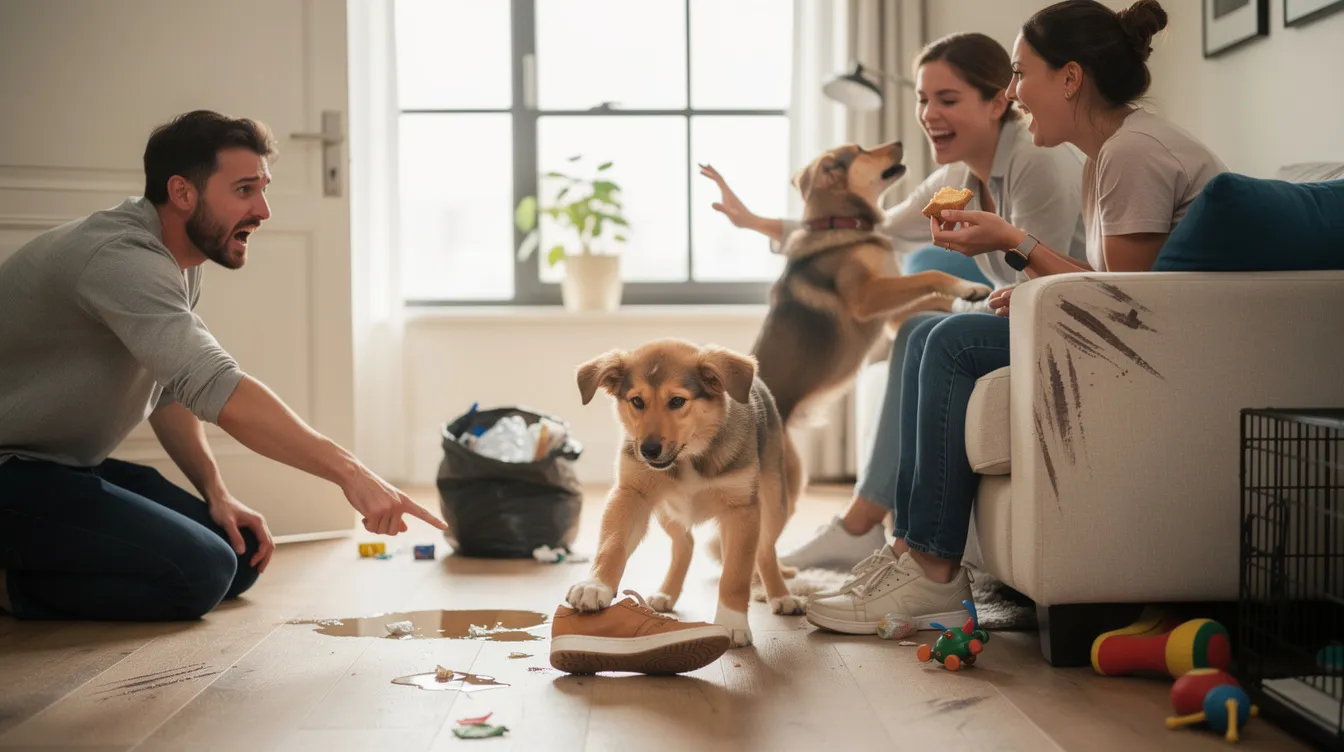
The mistakes that happen before 16 weeks-during that critical socialization and learning window-tend to create the most stubborn long-term behavioral issues. These aren’t minor setbacks. Each one compounds the others, and together they account for the majority of cases that eventually require professional intervention through programs like board and train.
Inconsistent Commands and Rules
Dogs learn best when commands remain the same. When one family member says “down,” another says “off,” and a third says “get down” for the same behavior, your puppy isn’t being stubborn-they genuinely don’t know what you want. Use the same command words each time for clarity. If sit means sit, it needs to mean sit for every person, every time, in every room of the house.
The inconsistency problem extends beyond verbal cues to rules. Allowing jumping sometimes but scolding it other times, or letting the puppy on the bed on weekends but not weekdays, creates anxiety and behavioral regression. Inconsistent training leads to confusion and disobedience. Puppies can’t understand context-dependent rules-they need the world to work the same way every time. When it doesn’t, they develop poor behavior patterns rooted in uncertainty, not defiance.
Expecting Immediate Results
Many owners expect instant results from puppy training, and this mismatch between expectation and reality is where frustration takes root. Expecting too much too soon can lead to frustration during training-for both owner and pup. Puppies have short attention spans and get tired quickly, often measuring success in seconds rather than minutes. Training requires time and repetition for success, and rushing the process doesn’t speed it up.
When dog owners become frustrated, they often escalate to harsher methods or give up on structure entirely. Both reactions damage trust. The reality is that training sessions should be short and fun-five to ten minutes of focused work produces better results than a 30-minute marathon that leaves your puppy overwhelmed. Training sessions longer than 10 minutes can overwhelm puppies and cause them to lose interest entirely, turning what should be a rewarding training game into a stressful ordeal.
Skipping Early Socialization
Skipping socialization can lead to fear or anxiety in dogs that persists throughout their entire life. Many dog owners wait until their puppy is fully vaccinated before introducing them to the world, but this well-intentioned caution often means missing the most critical developmental window entirely. Socialization involves exposing puppies to various environments-different surfaces, sounds, people of different ages and appearances, and controlled interactions with other dogs.
However, socialization must be done correctly. Introducing new experiences gradually is important for puppy confidence. Avoid overwhelming puppies during socialization to help build confidence-flooding a young pup with too much stimulation creates fear rather than resilience. Positive experiences during socialization are crucial for puppies, meaning each new exposure should be paired with treats, calm praise, and the freedom to retreat. Puppies learn through experience, making early socialization in a structured program invaluable for owners who want to get this right.
Accidentally Reinforcing Bad Behaviors
Accidentally reinforcing unwanted behaviors can complicate training in ways that take months to undo. Puppies quickly learn what “works”-if barking gets you to look, jumping gets hands on them, or nipping ends with attention of any kind, they’ll repeat those behaviors. Even negative attention (yelling “no!” or pushing the puppy down) registers as a reward because your pup got what they wanted: your engagement.
This is why ignoring unwanted behavior prevents accidental reinforcement. When your puppy jumps and you respond by giving treats to distract them, you’ve just taught them that jumping produces food. Allowing rehearsals of unwanted behavior makes it harder to correct later, because each repetition strengthens the neural pathway. Puppies should not rehearse unwanted behaviors to avoid future issues-this means managing the environment through supervised settings and redirecting to a chew toy before the bad habits form. The connection between unintentional reinforcement and escalating behavioral problems is direct and measurable.
Critical Training Technique Errors
Beyond the strategic mistakes covered above, specific technical errors in how owners execute training undermine even the best intentions. These execution problems are widespread-a study of obedience class participants found that correct responses were reinforced in only about 27% of commands, often with delays over 5 seconds, while 31% of commands received no reinforcement at all despite correct behavior.
Poor Timing and Reward Placement
Proper timing for rewards is essential for learning. Here are the four most common timing and placement errors:
- Waiting too long to reward correct behavior. Delayed corrections fail because puppies live in the present moment. Using rewards immediately after desired behavior enhances learning-anything beyond 3 seconds, and your puppy has already moved on mentally. Mark the exact moment of correct behavior with a clicker or verbal marker like “Yes!” before delivering the treat.
- Giving treats when the puppy is in the wrong position. If you ask your dog to sit and reward while they’re already standing back up, you’ve reinforced standing, not sitting. The reward must happen while the desired behavior is still occurring.
- Using treats as bribes instead of rewards. Holding food in front of your puppy’s nose before asking for behavior teaches them to work only when they see food. High-value treats should appear after the behavior, not before. Use high-value treats to effectively train puppies in distractions, but always as confirmation of good behavior, never as a lure.
- Failing to mark the correct moment. Without a clear marker (clicker, “good boy,” or “yes”), the puppy doesn’t know which specific action earned the reward. Rewarding good behavior builds trust and respect with dogs, but only when the puppy understands exactly what they did right.
Training Method Comparison
| Mistake | Professional Approach | Long-term Result |
|---|---|---|
| Punishment-based corrections (leash pops, yelling) | Positive reinforcement with clear boundaries | Confident, eager-to-learn dog vs. fearful, avoidant dog |
| Marathon training sessions (20+ minutes) | 5-10 minute focused sessions with structured play breaks | Maintained attention and faster learning vs. puppy who shuts down |
| Training only at home | Gradually work through different environments | Reliable obedience everywhere vs. dog who only listens in the kitchen |
| Repeating commands multiple times | Single cue, wait, then help | Dogs respond promptly vs. dogs that learn to ignore the first three repetitions |
Using punishment can create anxiety and fear in dogs. Research comparing aversive versus reward-based methods shows that dogs trained with punishment display more stress signals (yawning, lip-licking, pinned ears), perform worse on mood assessment tests, and develop increased fearful reactivity. Using physical punishment damages trust and increases fear. In contrast, positive reinforcement methods lead to better retention of new behavior even when rewards become intermittent over time.
Most dogs thrive when training feels like a fun collaboration rather than compliance under pressure. Life rewards-like getting to walk through the door, earning structured play, or receiving a pet-supplement food rewards and help puppies understand that good behavior produces good outcomes throughout their entire dog’s life.
Common Training Challenges and Professional Solutions
These challenges typically arise when one or more of the mistakes above have already taken root. The good news is that every one of them is solvable-but correction takes more time, patience, and consistency than prevention would have.
Puppy Ignoring Commands
Repetitive commands can teach puppies to ignore cues. If you say “sit” five times before your puppy responds, you’ve trained them that “sit” actually means “sit on the fifth ask.” The AKC warns this breeds the expectation of eventual obedience rather than immediate response.
The fix: get your puppy’s attention first (say their name, wait for eye contact), deliver a single command using consistent hand signals or verbal cues, and wait about 10 seconds. If there’s no response, gently guide them into position rather than repeating. Always reward compliance. Start in quiet, low-distraction settings and gradually work up to more challenging new environments. Stay calm throughout-your frustration only adds stress that makes learning harder.
Regression After Initial Progress
Your puppy masters sit one week and seems to forget it the next. This regression is normal during teething (3-6 months), growth spurts, and hormonal changes. It doesn’t mean your training failed. Neglecting rest and enrichment can lead to behavioral issues in puppies during these phases, so make sure your pup is getting adequate sleep and mental stimulation through puppy-appropriate enrichment.
Professional trainers recommend increasing reward frequency temporarily, returning to simpler environments, and avoiding adding new behavior goals until existing behaviors are stable again. Puppies need structured enrichment to prevent behavioral issues, but the type and intensity should match their current developmental stage.
Puppy Only Listens to One Family Member
This happens when one person handles all the dog training while everyone else gives inconsistent cues or breaks the rules. Your pup isn’t choosing favorites-they’ve simply learned that only one person communicates in a predictable, rewarding way.
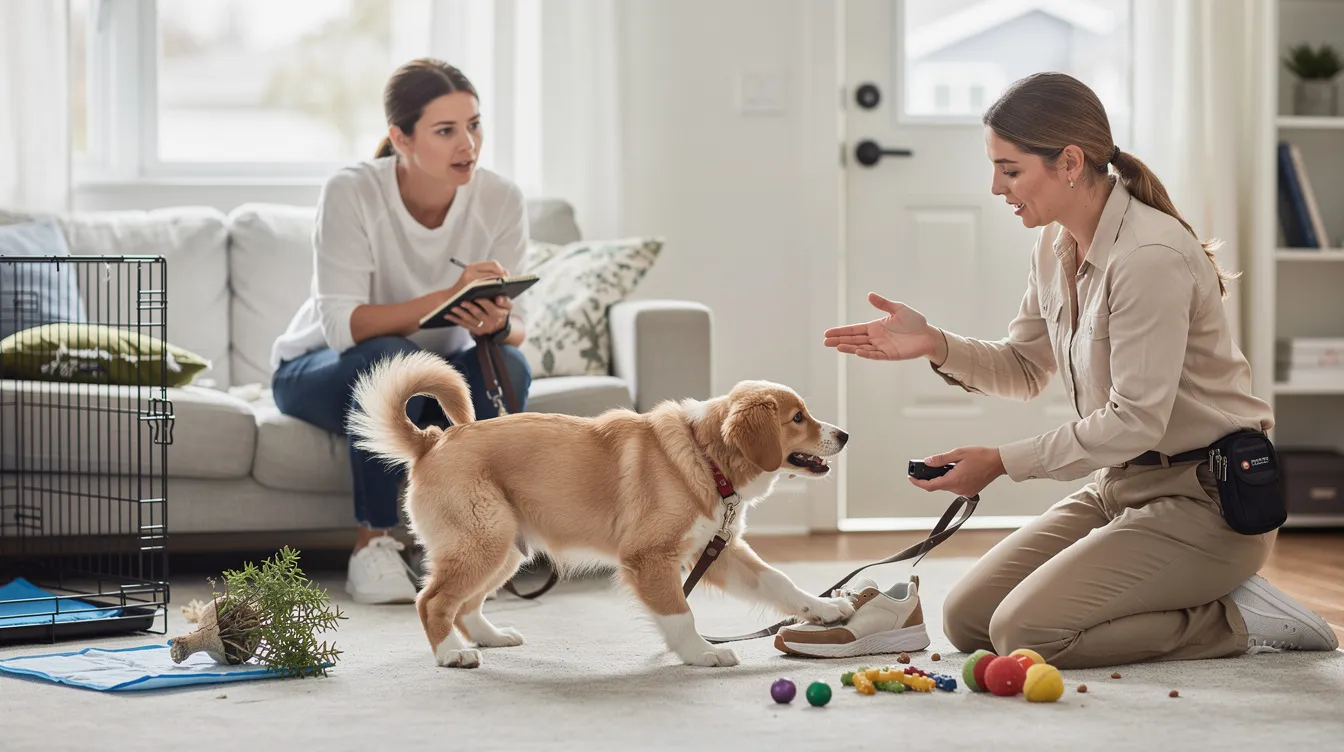
The fix requires all family members to learn identical language for cues, the same reward structure, and the same expectations. Each person should run separate training sessions with the puppy. Avoid having the “main trainer” always step in when others struggle-this only reinforces the problem. Professional obedience training that includes owner coaching ensures everyone in the house is on the same page.
Overwhelmed by Multiple Behavioral Issues
When bad habits have stacked up-jumping on visitors, pulling on leash during leash training, having potty training setbacks, resource guarding food, barking at every noise-trying to fix everything at once guarantees failure. Attention gets thin, consistency suffers, and both owner and puppy end up frustrated.
Focus on one behavior at a time, starting with safety priorities: recall, impulse control, and any aggression-related issues. Supervised environments can prevent unwanted behaviors in puppies while you work on one problem systematically. For cases involving multiple serious issues, consider a professional board-and-train program that provides the immersive, consistent environment most owners can’t replicate at home. Puppies should sleep in a crate until house training is complete, and proper crate training alone can resolve several issues simultaneously-including separation anxiety and destructive behavior when unsupervised.
Conclusion and Next Steps
Every mistake on this list is preventable with proper knowledge and consistency. The pattern is clear: dogs respond best to clear communication, immediate rewards, early socialization, and rules that don’t change based on who’s in the room or what day it is. Positive training methods produce confident, well-adjusted dogs. Punishment, impatience, and inconsistency produce fearful, reactive ones. The research is unambiguous, and the stakes are your dog’s entire life.
Here’s what to do right now:
- Assess your current approach. Are all family members using the same verbal cues and hand signals? Is anyone accidentally rewarding bad behavior? Read your puppy’s body language during training-stress signals like yawning, lip-licking, or tucked ears mean you need to adjust.
- Implement one change this week. Whether it’s tightening your reward timing, shortening training sessions, or starting controlled socialization outings, pick one thing and do it consistently.
- Schedule a consultation if multiple issues exist. When problems have compounded-or you’re seeing fear, aggression, or persistent unwanted behavior despite consistent effort-professional guidance saves months of struggle. Off Leash K9 Training offers a free phone consultation to assess your training needs and recommend next steps.
For dog owners ready to go further, topics like leash training refinement, advanced off-leash obedience, and therapy dog preparation build on these foundations. But none of it works without the basics covered here. Get these right first, and you’ll have a dog who doesn’t just listen-but genuinely wants to.
Additional Resources
- Free Phone Consultation: Contact Off Leash K9 Training to discuss your puppy’s specific challenges and get a professional assessment of your training needs.
- Board-and-Train Programs: 2-week and 3-week board-and-train options provide comprehensive behavior modification in an immersive, professional environment-ideal when early mistakes have created compounding issues.
- Local Training: Facilities in Christiansburg and Vinton/Roanoke serve the New River and Roanoke Valleys with in-person puppy training and obedience programs.