

Puppy obedience training should begin the moment you bring your new pup home, typically at 8 weeks old. That first day isn’t too early. Your puppy is already learning from every interaction, routine, boundary, and response, whether you realize it or not.
This guide covers the complete puppy training timeline from 8 weeks through early puppyhood and into adolescence, which commonly begins between 6 and 12 months and may continue until 18 to 24 months. It gives new dog owners a structured, science-backed framework for what to teach and when. Whether you’re bringing home your first puppy or adding a new member to a multi-dog household, this resource addresses the developmental milestones that influence training progress and the timing mistakes that can create long-term challenges.
The direct answer: Start basic puppy training as soon as your puppy comes home, typically around 8 weeks old, with simple cues, socialization, house training, and clear household rules. Properly managed puppy classes can begin as early as 7–8 weeks when appropriate vaccination, deworming, health, and sanitation requirements are met. Program requirements vary, so always confirm the minimum age before enrolling.
Here’s what you’ll walk away with:
- A clear understanding of your puppy’s critical learning windows and why they matter
- An age-specific breakdown of what you can teach at each stage
- Practical guidance on training methods, session length, and professional training options
- Strategies to avoid common timing mistakes that lead to unwanted behaviors
- A solid foundation for building toward advanced off-leash control
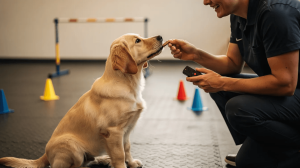
Understanding Puppy Development Stages
Your puppy’s brain doesn’t develop on a flat curve. There are specific windows when puppies are especially receptive to certain types of social and environmental learning. Understanding these stages is the difference between training that builds confidence and training that creates frustration for both you and your dog.
Puppies develop rapidly between 8 and 11 weeks, a stage that overlaps with both the broader socialization period and the first fear period. By this age, puppies already demonstrate developing memory, social communication, and problem-solving abilities. However, self-control emerges more gradually. Research discussed by the AKC found that puppies began showing self-control around 10 weeks and reached adult-like performance on certain laboratory tasks at approximately 12–14 weeks of age.
This does not mean a 12-week-old puppy has the impulse control of an adult dog in everyday situations. Young puppies still need supervision, environmental management, clear expectations, and training exercises suited to their developmental abilities.
The Early Socialization Window
The primary socialization period begins at approximately 3 weeks and continues through about 12 weeks, although puppies may remain especially receptive to new experiences until roughly 16–20 weeks. For most owners, the weeks immediately after bringing a puppy home are therefore especially important.
During this time, carefully managed exposure to people, healthy animals, sounds, surfaces, handling, and different environments can help build confidence and reduce the risk of later fearful behavior. Socialization is not simply allowing a puppy to greet every person or dog. It involves helping the puppy observe, explore, and experience the world without being frightened or overwhelmed.
Socialization begins before puppies are weaned, with breeders or early caregivers introducing appropriate handling, surfaces, sounds, people, and safe experiences. Owners should continue that process after bringing the puppy home.
A systematic review of canine socialization research found that inadequate early social exposure is associated with a greater risk of fearful or withdrawn behavior. However, socialization cannot guarantee that a dog will never develop reactivity, separation-related problems, or aggression. Genetics, health, temperament, traumatic experiences, and continued learning also influence adult behavior.
Missing part of the early socialization period does not make later training pointless. Dogs remain capable of learning throughout puppyhood and adulthood, although cautious or fearful dogs may need more gradual exposure and professional support.
Early Learning Phase (8–12 Weeks)
Puppies can begin learning simple cues such as sit, come, and their name by 8 weeks. During this phase, your puppy is capable of forming associations between behaviors and outcomes, recognizing familiar routines, and practicing very simple impulse-control exercises.
What makes this phase unique is that puppies have short attention spans and limited self-control. You’re not building a fully trained adult dog yet. You’re creating positive associations with learning itself.
Consistent early practice can provide a useful foundation for later obedience by helping puppies become familiar with attention, recall, rewards, handling, and simple household expectations. Continued progress still depends on the individual puppy, training quality, temperament, health, consistency, and ongoing practice.
Focused Training Window (12–20 Weeks)
Around 12 weeks, many puppies begin showing improvements in attention and physical control. Research involving Labrador puppies found that social communication abilities appeared early, while the puppies reached adult-like performance on certain self-control tasks at approximately 12–14 weeks.
This does not mean all puppies develop at the same pace. One puppy may be ready for slightly longer exercises, while another still needs sessions lasting only a minute or two. Training should progress according to the puppy in front of you rather than a rigid calendar.
Many puppies can handle more complex exercises, slightly longer sessions, and carefully introduced distractions between 4 and 6 months. However, there is no single ideal age that applies to every puppy or training format. Properly managed puppy socialization classes may begin as early as 7–8 weeks, while more demanding obedience programs may set higher minimum ages.
Waiting beyond this period does not make training ineffective. Early, appropriate practice simply provides a valuable foundation that owners can continue building throughout adolescence and adulthood.
Age-Appropriate Training Components
Now that you understand how your puppy develops at each stage, here’s what you can teach and when. Puppies are especially receptive to social and environmental learning during their early sensitive period, but they remain capable of learning throughout puppyhood and adulthood.
Structuring training around developmental readiness helps make each session productive without treating any age as a hard deadline.
Immediate Start Training (8–12 Weeks)
Establishing a consistent potty training routine should start from day one. When you bring your new pup home, puppy potty training and crate training are immediate priorities.
Take your puppy out for potty breaks after meals, naps, play sessions, and periods of confinement. Consistency helps reduce indoor accidents and teaches your puppy where elimination should occur.
Puppy training can start as early as 8 weeks old with these fundamentals:
- Name recognition and eye contact: Say your puppy’s name and reward them when they look at you. This attention cue creates a foundation for later commands.
- Crate training: Introduce the crate as a safe, positive space. Keep the crate experience rewarding with treats, food toys, and calm praise.
- Simple commands: Basic cues such as sit and come can be introduced at 8 weeks. Asking for a sit before meals or playtime can become an early impulse-control exercise.
- Gentle handling: Use rewards while briefly touching your puppy’s paws, ears, and mouth so they gradually become comfortable with routine handling.
- Leash introduction: Allow your puppy to become comfortable wearing a properly fitted collar or harness and lightweight leash in a secure indoor area.
Puppies can begin learning through rewards at 8 weeks old. Keep sessions brief, often between one and five minutes depending on your puppy’s engagement, and repeat them throughout the day.
The goal is not to reach a fixed amount of daily training time. End each session while your puppy is still interested rather than continuing until they become distracted, frustrated, or tired.
Foundational Obedience (12–16 Weeks)
During this period, many puppies become better able to practice core obedience cues. These may include sit, down, come, stay, leave it, and place.
Recall training should begin in a secure, low-distraction area. Reward your puppy generously for moving toward you, and avoid calling them for something they consistently find unpleasant. A reliable recall takes months of gradual practice and should not be tested off leash in an unsecured location.
Continue leash training inside the home, in a secure yard, or in another low-risk environment. Gradually introduce calm outdoor settings based on your puppy’s vaccination status and your veterinarian’s recommendations.
Practice calm observation and polite greetings with people. When introducing other dogs, choose healthy, appropriately vaccinated dogs known to be calm and socially suitable. Socialization does not require direct interaction with every dog your puppy sees.
A puppy that begins responding to basic cues such as sit, down, and come develops a useful foundation for more structured obedience programs. However, those early responses will not yet be reliable in every environment. Difficulty usually needs to increase gradually through distance, duration, and distraction.
Continue introducing your puppy to people, surfaces, sounds, handling, and environments during this period. Keep each experience positive and allow your puppy to observe from a comfortable distance rather than forcing interaction.
Structured Program Entry (16–20 Weeks)
By 16–20 weeks, many puppies are ready for more structured obedience work, increasing distractions, and short exercises in new environments. Formal puppy instruction can begin earlier when the class is appropriate for the puppy’s age, health, and developmental needs.
Session length should remain flexible, often ranging from a few minutes to about 5–10 minutes depending on the puppy’s interest, energy, and ability to remain engaged.
More advanced training at this stage may include:
- Gradually increasing the duration of sit, down, and place
- Practicing recall over longer distances with a leash or long line
- Developing leash manners around manageable distractions
- Practicing calm behavior near real-world sights and sounds
- Reinforcing consistent cue meanings across family members
- Introducing safe public environments based on veterinary guidance
Continue exposing your puppy to new environments through safe, positive experiences. The sensitive socialization period becomes less pronounced rather than closing completely on a particular day, so thoughtful exposure should continue through adolescence and adulthood.
Follow your veterinarian’s guidance about disease risk. Avoid dog parks and heavily trafficked areas used by dogs of unknown health or vaccination status until your puppy is appropriately protected.
Training Methods and Implementation
Building on the age-appropriate components above, let’s address how to implement training in daily life and when professional support makes sense.
Home-Based Training Approach
Home-based training is appropriate at every stage, and much of a young puppy’s learning happens during everyday routines. Training your puppy effectively at home requires structure, not perfection.
Training sessions should be short enough to maintain your puppy’s focus. For puppies 8–12 weeks old, sessions may last 1–2 minutes each, repeated several times daily. Other puppies may remain happily engaged for a few minutes longer. By 12–16 weeks, many can gradually work toward sessions lasting 3–5 minutes.
Integrate training into daily routines rather than treating it as a separate activity. Ask for a sit before meals, practice a brief wait at doorways, or reward your puppy for coming to you before the leash is clipped on. This approach makes training feel like fun rather than work and creates frequent micro-practice opportunities.
Consistency matters enormously in the early days. Every family member should use each cue for the same behavior. For example, “down” can mean lying on the floor, while “off” can mean putting four paws back on the ground. Puppies can learn both words when their meanings remain clear.
Environmental management, including baby gates, supervised leash tethering, puppy pens, and removing tempting objects, sets your puppy up for success rather than relying on corrections after mistakes occur.
Track what your puppy can do reliably and what still needs work. Once a cue is dependable in a low-distraction indoor setting, practice in a secure yard or another slightly more challenging location. Increase difficulty one element at a time so your puppy is not asked to manage greater distance, duration, and distraction all at once.
Professional Training Options Comparison
Choosing between professional training formats depends on your puppy’s age, temperament, house-training progress, and your goals. The following options reflect the programs currently described by the provider:
| Program | Current Age Requirement | Format and Focus |
| Puppy Lessons | Over 10 weeks through 6 months | Six 30-minute lessons covering engagement, markers, come, sit, down, place, leash manners, routine, structure, and exposure |
| Puppy Jump Start | 3–6 months | Three-week residential, non-e-collar program covering on-leash commands, marker training, crate routines, potty-training foundations, and supervised exposure |
| Basic Obedience Lessons | Minimum 5 months | Four private one-hour lessons covering core commands, loose-leash walking, and everyday manners |
| Two-Week Board & Train | Minimum 5 months at the start | Residential obedience program for fully house-trained dogs; the trainer may recommend waiting longer depending on breed and individual needs |
For puppies just entering structured training, puppy lessons guide dogs over 10 weeks and up to 6 months old. The three-week Puppy Jump Start is available for puppies from 3 to 6 months and is designed to build early foundations.
Standard board and train programs generally require dogs to be at least five months old, and the two-week program requires dogs to be fully house trained. Age eligibility does not automatically mean every puppy is ready for the same program, so temperament, behavior, health, breed, and training goals should also be considered.
The key synthesis is that no single format is universally best. A trainer working with a young puppy in private lessons may recommend transitioning to a more advanced course once the puppy meets the program’s minimum age and is developmentally ready. Match the format to your puppy’s needs rather than choosing based only on speed or convenience.

Common Challenges and Solutions
Even with the best intentions, timing-related training difficulties are common. Here’s how to address three frequent problems.
Starting After 20 Weeks
If training begins after 20 weeks, your puppy is past the most sensitive portion of early socialization, but it is not too late to teach obedience or create positive experiences.
Some puppies may already show fear or hesitation around unfamiliar people, dogs, sounds, or environments, while others may not. Behavior at this age depends on genetics, previous experiences, health, temperament, and the puppy’s early environment.
Puppies showing fear or reactivity may benefit from controlled exposure, desensitization, counterconditioning, environmental management, and guidance from a qualified professional experienced in behavior modification.
Progress is individual and is not automatically slower simply because training began after 20 weeks. Reward-based methods are supported by veterinary behavior guidance, while serious fear, anxiety, or aggression may also require assessment by a veterinarian or veterinary behaviorist.
Inconsistent Early Training
Inconsistency is one of the most common reasons early training fails to produce lasting results. When rules shift between family members, sessions happen sporadically, or cue meanings change from day to day, puppies have difficulty predicting what behavior will earn a reward.
The solution is a structured routine and family coordination. Hold a brief family meeting to agree on cue words, household rules, and who handles each part of the puppy’s daily routine. Write the rules down so everyone can follow the same plan.
Practice daily, even if sessions last only 2–3 minutes. Training can strengthen the relationship between puppies and their owners when expectations are clear, and the puppy can consistently predict what earns a reward.
Overwhelming Young Puppies
Young puppies placed in high-distraction environments or asked to perform exercises they are not ready for may become distracted, frustrated, worried, or disengaged. Showing frustration, using dominance-based handling, or pushing sessions beyond your puppy’s attention capacity can create negative associations with training.
Keep training sessions short, often 1–2 minutes for very young puppies, and gradually build toward several minutes. If your puppy loses focus, simplify the exercise or end the session.
Reward reasonable approximations of the desired behavior rather than waiting for perfection. For example, reward one second of calm attention before expecting five seconds. Early training helps establish useful habits when the puppy experiences learning as clear, manageable, and rewarding rather than stressful.
Conclusion and Next Steps
The puppy training timeline begins as soon as your puppy comes home, typically around 8 weeks old. Start with house training, socialization, name recognition, simple cues, crate routines, gentle handling, and leash introduction.
Properly managed puppy classes may begin earlier than many owners expect, while individual professional programs can have higher minimum ages. As your puppy develops, gradually increase the duration, distance, and distraction involved in each exercise.
Early training can help puppies build confidence, social skills, household manners, and trust with their owners. Current veterinary behavior guidance supports reward-based training and sessions suited to the puppy’s attention span.
Starting young provides a valuable foundation, but it cannot guarantee a well-behaved adult dog. Genetics, health, temperament, later experiences, and continued owner practice also influence adult behavior.
Your immediate next steps:
- Assess your puppy’s current age, health, and previous experiences
- Start safe socialization and simple cue training today, even if each session lasts only a minute or two
- Ask your veterinarian which public environments and puppy classes are appropriate based on vaccination status and local disease risk
- Compare training formats and choose one suited to your puppy’s age, temperament, and current skills
- Request a free consultation for personalized guidance based on your puppy and training goals
For dog owners in the New River and Roanoke Valleys interested in building off-leash reliability, managing reactive behavior, or comparing board and train options, the right time to start planning is now. Training begins with the routines and expectations your puppy experiences from the day they come home.
Frequently Asked Questions
When should I start obedience training with my puppy?
Start basic obedience training as soon as your puppy comes home, typically around 8 weeks old. Begin with name recognition, sit, come, house rules, crate routines, and short, positive training sessions.
How long should puppy training sessions last?
Keep sessions short enough to match your puppy’s attention span. Very young puppies may train for only 1–2 minutes at a time, while older puppies may gradually work toward sessions lasting 5–10 minutes.
Why is early socialization important?
Socialization begins at approximately 3 weeks, although owners often take over much of the process after bringing a puppy home around 8 weeks. Safe, positive exposure to people, animals, environments, handling, and sounds can build confidence and reduce the risk of later fear-related behavior, but it cannot prevent every case of aggression or anxiety.
Can I start leash training at 8 weeks?
Yes. You can introduce a lightweight leash and properly fitted harness or collar at around 8 weeks. Start indoors or in a secure, quiet area, using rewards to help your puppy become comfortable following you without pulling or resisting.
When is the best time to enroll my puppy in formal obedience classes?
Properly managed puppy socialization classes may begin as early as 7–8 weeks when vaccination, deworming, health, and sanitation requirements are met. Individual programs set their own age limits; this provider offers puppy lessons for dogs over 10 weeks, while its Basic Obedience program begins at five months.