
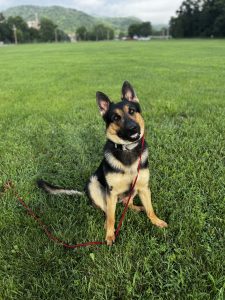
To teach dog recall, begin in a quiet environment, choose a clear cue such as “Come,” and reward your dog for approaching you. Practice at short distances before gradually introducing new locations and distractions. Keep your dog safely leashed or in a secure area until its response is reliable enough for more challenging practice.
Recall is one of the most useful obedience skills a dog can learn. It helps you communicate during everyday activities, redirect your dog’s attention, and bring your dog closer when you need to manage a situation.
However, calling a dog away from an interesting smell, another animal, or a moving distraction can be difficult. Dogs need repeated practice to understand that returning to their owner is worthwhile.
For dog owners in Roanoke, Blacksburg, Christiansburg, and the surrounding New River Valley, recall training can support safer walks, better communication, and more manageable outdoor activities.
This guide explains how to teach the recall command, build consistency, and avoid common training mistakes.
What Is Dog Recall Training?
Dog recall training teaches a dog to return to its handler after hearing a specific cue.
Common recall cues include:
- Come
- Here
- To me
The word itself is less important than how consistently you teach and use it.
For example, when you say “Come,” your dog should learn to move toward you and reach a position where you can reward or safely manage it.
A reliable recall involves more than briefly looking at you.
Your dog needs to approach and remain close enough for you to provide a reward, attach a leash if necessary, or give another familiar instruction.
Why Recall Matters
Recall is useful in several situations:
- Calling your dog away from an open doorway
- Asking your dog to return during play in a secure area
- Redirecting your dog from distractions
- Managing movement around family members
- Practicing obedience at increasing distances
Recall can also be part of emergency preparation.
However, no training cue guarantees that a dog will respond in every situation.
Continue using appropriate leashes, fences, gates, and supervision around traffic, unfamiliar animals, and other hazards.
Why Doesn’t My Dog Come When Called?
A dog that fails to return is not necessarily being stubborn.
Several factors can affect recall.
The Cue Has Not Been Fully Learned
Your dog may understand “Come” indoors but not recognize what you expect in another environment.
Dogs need practice in different locations before a behavior becomes consistent across settings.
Distractions Are More Interesting
Wildlife, unfamiliar smells, other dogs, and moving objects can compete for your dog’s attention.
If your dog has only practiced recall in the living room, expecting an immediate response around a squirrel may be too difficult.
Coming to You Ends the Fun
Some dogs learn that returning to their owner means playtime is over.
If you only call your dog before leaving the yard or going inside, the cue may become less appealing.
Include practice recalls that end with your dog being released to continue an enjoyable activity.
The Cue Is Repeated Too Often
Repeating “Come, come, come” while your dog ignores you can make the cue less clear.
Instead, practice in a setting where your dog is likely to respond.
The American Kennel Club’s recall training guidance also emphasizes rewarding returns, avoiding repeated cues, and building difficulty gradually.
What You Need Before Teaching Recall
You do not need complicated equipment to begin.
Prepare:
- Small rewards your dog enjoys
- A quiet indoor training space
- A familiar recall cue
- A comfortable harness or collar
- A suitable leash for outdoor practice
- A secure area for exercises that require more movement
A long line may be useful for later outdoor practice when the environment is appropriate.
Use it under supervision and avoid locations where it could become tangled around people, animals, or obstacles.
Training should begin at a level your dog can handle comfortably.
Step-by-Step: How to Teach a Dog to Come When Called
Start with simple exercises and gradually build toward more challenging situations.
Step 1: Choose One Recall Cue
Select one word that your household can use consistently.
For example, you might choose “Come.”
Avoid switching between several unfamiliar words during early training.
Say the cue clearly and in a friendly tone.
You want the word to become associated with returning to you and receiving something rewarding.
If your dog already has a recall cue that has been repeatedly ignored or associated with unpleasant experiences, consider introducing a new cue and teaching it from the beginning.
Step 2: Build Positive Associations
Start with your dog near you in a quiet room.
Say the chosen recall word and immediately give a small reward.
Repeat a few times without requiring your dog to perform a difficult behavior.
This helps establish a positive association with the cue.
Keep sessions brief and stop while your dog remains interested.
Once your dog is comfortable with the word, begin teaching the actual movement toward you.
Step 3: Reward Your Dog for Moving Toward You
Begin a short distance from your dog.
When your dog is likely to approach, say the recall cue once.
Encourage movement toward you using a friendly voice or inviting body language.
As your dog approaches:
- Allow it to come all the way to you.
- Mark the successful arrival if it understands a marker word.
- Provide a reward.
- Give your dog a moment before the next repetition.
Reward the completed return rather than only the first glance toward you.
At this stage, do not require a formal sit unless your dog already knows that behavior and you are intentionally adding it to the exercise.
Step 4: Gradually Increase Distance
When your dog consistently approaches from a short distance, move a little farther away.
Practice across a familiar room before trying another indoor location.
Keep the environment easy.
If your dog stops responding, reduce the distance and reward an easier return.
Do not increase distance and distractions at the same time.
Your dog should understand the exercise before you make it more challenging.
Step 5: Practice in Different Rooms
Dogs may perform a behavior successfully in one location but struggle elsewhere.
Practice recall in several familiar indoor areas.
For example:
- Living room
- Hallway
- Kitchen
- Another quiet room
Make each new location easier at first.
Start nearby, reward successful returns, and gradually increase the distance.
This helps your dog learn that the recall cue applies beyond one particular training spot.
Step 6: Introduce a Secure Outdoor Environment
Once your dog responds comfortably indoors, begin practicing outside.
Choose a quiet, secure setting with minimal distractions.
Keep your dog on an appropriate leash or long line when needed.
Start close to your dog and practice short recalls.
Reward every successful return during the early stages.
Avoid letting your dog drag a long line near hazards or using one where it can catch on objects.
Outdoor training should remain controlled until your dog has developed stronger skills.
Step 7: Add Distractions Gradually
Begin with distractions your dog can notice without becoming overwhelmed.
A family member walking at a distance or a stationary object may provide an easy starting point.
If your dog remains comfortable, practice recalling it away from the mild distraction.
Reward the return promptly.
As your dog improves, gradually introduce different situations.
If your dog becomes highly focused on something else or cannot respond, increase distance from the distraction.
The goal is to build repeatable success, not to test your dog in the hardest possible environment.
Three Recall Games to Practice
Recall games can make repetition enjoyable while strengthening your dog’s response.
1. The Back-and-Forth Recall Game
Ask another household member to help.
Stand a short distance apart in a quiet room.
One person calls the dog and rewards its arrival.
After a brief pause, the other person calls.
Continue taking turns.
Avoid calling at the same time.
The dog should learn to respond to the person giving the cue rather than simply chasing visible treats.
2. The Follow-Me Game
Begin with your dog near you.
Move a few steps away and encourage your dog to follow.
When your dog approaches, reward it.
As the exercise becomes familiar, add the recall cue before your dog starts moving.
Avoid running suddenly while the leash is tight.
This game works best when you have enough space for comfortable movement.
3. The Find-Me Game
Once your dog understands basic recall, practice calling from another room.
Begin where your dog can easily locate you.
Reward the return.
Later, you can introduce a simple hiding location, such as standing just beyond an open doorway.
Do not make the game so difficult that your dog becomes distressed.
The AKC’s guide to recall games offers additional ways to make returning to the handler rewarding.
How to Teach Recall With a Long Line
A long line allows your dog to practice at a greater distance while remaining physically connected to you.
It can be useful when your dog is not ready for unrestricted off-leash activity.
Choose an appropriate open area away from traffic and other hazards.
Before beginning:
- Check the equipment for damage.
- Attach it to a suitable, securely fitted harness.
- Keep the line from wrapping around your hands or legs.
- Avoid allowing the line to become tangled.
- Maintain enough control to prevent your dog from reaching unsafe areas.
Let your dog explore within a manageable distance.
When it is likely to respond, say the recall cue once.
Reward the completed return.
Do not use the long line to jerk your dog toward you.
If your dog does not respond, make the next attempt easier rather than repeatedly calling.

Common Dog Recall Training Mistakes
Repeating the Recall Cue
Repeated calling without a response can weaken the cue’s clarity.
Practice at a shorter distance or in a quieter environment.
Use the cue when your dog has a reasonable chance of responding.
Punishing a Dog After It Comes Back
Do not scold your dog for returning slowly.
Your dog may associate the unpleasant interaction with coming to you rather than with whatever happened earlier.
Reward the return, then adjust future practice so the exercise is easier.
Always Ending Play After Recall
If recall consistently ends an enjoyable activity, your dog may become reluctant to return.
Sometimes call your dog, reward it, and release it to continue playing in a safe environment.
Moving Too Quickly to Busy Places
A dog that returns indoors may not yet respond around other dogs, wildlife, or traffic.
Introduce distractions gradually.
Showing the Treat Every Time
Visible food can help during early learning, but your dog should eventually learn to respond to the cue itself.
As the behavior develops, keep rewards out of sight until your dog returns.
Continue rewarding successful recalls.
How to Build a More Reliable Recall Around Distractions
Reliability develops through practice in different situations.
You can gradually work on three factors:
| Factor | Example | How to progress |
| Distance | Calling from across a room | Increase the distance gradually. |
| Distraction | Practicing near a moving family member | Begin far away and increase difficulty slowly. |
| Location | Moving from the living room to a secure yard | Make the first session in each new place easier. |
Change one factor at a time.
For example, if you move to a new outdoor setting, begin with short-distance recalls even if your dog can return from farther away indoors.
Observe whether your dog can respond without repeated prompts.
If responses become less consistent, lower the difficulty.
Does Reliable Recall Mean My Dog Can Walk Off Leash?
No. A strong recall response is important, but it does not automatically establish that unrestricted off-leash activity is safe.
Your dog may respond consistently in familiar settings and still struggle with unexpected wildlife, loud noises, other dogs, or sudden movement.
Consider:
- Your dog’s behavior history
- The environment
- The presence of traffic or other hazards
- Applicable leash requirements
- Your dog’s response around distractions
- Whether the area is securely enclosed
A dog with fear, reactivity, or a history of running away may require a different management plan.
Do not test recall beside roads or in other dangerous locations.
Off-leash readiness should be assessed cautiously and individually.
Can Reactive Dogs Learn Recall?
Yes, reactive dogs can learn recall skills.
However, recall training alone does not resolve fear, frustration, or aggressive behavior.
A dog that barks and lunges at triggers may need additional behavior support before practicing recall near those distractions.
Begin in a comfortable environment and avoid forcing the dog into overwhelming encounters.
For more information, read our guide to leash reactivity in dogs.
If reactions include snapping, biting, redirected aggression, or difficulty maintaining safe control, seek individualized professional assistance.
How Long Does It Take to Teach Dog Recall?
There is no guaranteed timeline.
Progress depends on your dog’s age, previous learning, motivation, environment, and consistency of practice.
Some dogs learn to return a short distance indoors relatively quickly.
Responding around distractions may require substantially more practice.
Instead of measuring success by the number of training days, watch for improvements such as:
- Returning promptly in a quiet room
- Responding from farther away
- Returning in another familiar location
- Responding while mild distractions are present
- Remaining close long enough to receive a reward or have a leash attached
These are training milestones, not proof that your dog is safe in every environment.
When to Seek Professional Help With Dog Recall
Consider professional guidance if your dog struggles to respond in easy settings, frequently runs away, or becomes difficult to manage outdoors.
A trainer can help evaluate your dog’s current skills and suggest appropriate training exercises.
The New River and Roanoke Valleys website lists obedience and residential training options that include recall-related skills. Program suitability depends on your dog’s age, behavior, and training needs.
You can review the dog training packages and pricing to compare available options.
For an example of recall work within a local training program, read how Chance worked on focus, recall, and Place training in Blacksburg, VA.
If you would like guidance choosing a suitable option, contact the training team to discuss your dog’s needs.
Professional training can support progress, but no program guarantees a perfect response in every situation.
Frequently Asked Questions About Dog Recall Training
What is the easiest way to teach a dog to come when called?
Start a short distance away in a quiet room. Use one recall cue, encourage your dog to approach, and reward the completed return. Gradually add distance and distractions as your dog becomes comfortable.
Can an older dog learn recall?
Yes. Adult and senior dogs can learn recall skills. Training should account for previous experience, health, hearing, mobility, and individual comfort.
Why does my dog come when called at home but not outside?
Outdoor environments contain more distractions. Your dog may not yet understand how to respond to the cue in those settings. Begin with easier outdoor exercises in a secure area and gradually increase difficulty.
Should I repeat the Come command if my dog ignores it?
Avoid repeatedly saying the cue. Make the next attempt easier by moving closer, reducing distractions, or returning to an earlier training step.
Should I use treats every time I practice recall?
Food rewards can be especially useful during early training. You can also use toys, play, and access to enjoyable activities when appropriate. Keep successful returns rewarding, particularly in difficult situations.
Is recall training the same as off-leash training?
No. Recall is the behavior of returning when called. Off-leash training may involve additional skills, safety considerations, and practice around distractions. Learning recall does not automatically make unrestricted off-leash activity appropriate.
Build Stronger Recall Through Consistent Practice
Teaching your dog to come when called starts with making each successful return clear, rewarding, and easy to repeat.
Practice short-distance recalls in a quiet environment before introducing new locations and distractions. Reward successful returns, avoid repeating unanswered cues, and continue using appropriate leashes, barriers, and supervision while training develops.
If your dog struggles to come when called or you want help building stronger obedience around distractions, explore the available dog training programs and discuss your goals with the team.