
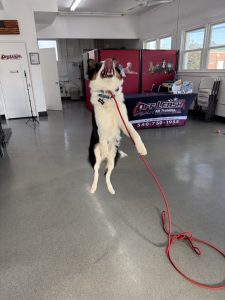
To stop a dog from jumping on guests, teach a greeting behavior you want to see, reward it consistently, and prevent jumping while your dog is still learning. Start with calm practice sessions, use a leash or gate to manage arrivals, and ask visitors to give attention only when your dog keeps all four paws on the floor.
A dog that jumps on visitors is not necessarily trying to misbehave. Many dogs become excited when someone enters the home. Jumping may also have worked in the past because it earned attention, petting, or conversation.
Whether you live in Roanoke, Blacksburg, Christiansburg, or elsewhere in the New River Valley, the same basic principles apply: manage the greeting, teach an alternative behavior, and practice at a level your dog can handle.
Why Do Dogs Jump on Guests?
Dogs often jump because they want to interact with the person arriving. Jumping brings them closer to someone’s face and can quickly attract attention.
For example, imagine a guest entering your home. Your dog jumps, and the guest laughs, talks to the dog, or reaches down to pet it.
Even if the guest says, “Get down,” the dog may still receive the interaction it wanted.
Over time, jumping can become a learned greeting habit.
Other factors may contribute:
- Excitement: Your dog becomes highly aroused when someone arrives.
- Attention-seeking: Jumping has previously resulted in interaction.
- Limited greeting skills: Your dog has not learned what to do instead.
- Inconsistent expectations: Some visitors encourage jumping while others discourage it.
- Frustration: Your dog wants to reach a visitor but cannot do so immediately.
Not every jump has the same motivation. Dogs may also jump when they are worried, conflicted, or trying to create distance through movement.
Watch the rest of your dog’s behavior. A loose, wiggly dog approaching willingly may be experiencing excitement, while a stiff dog that barks, retreats, or growls may need a different approach.
Start by Preventing Jumping at the Door
Training is easier when your dog cannot repeatedly practice the unwanted behavior.
Before guests arrive, prepare a safe way to manage your dog’s movement.
Use a Leash, Gate, or Separate Room
Depending on your dog’s comfort and the layout of your home, you can:
- Attach a leash to a comfortable harness and supervise your dog during the greeting.
- Use a secure baby gate to create distance from the entrance.
- Have your dog wait in another comfortable room until the initial excitement passes.
- Use a familiar resting area if your dog is already comfortable there.
Do not leave a dog tethered or unattended on a leash. Avoid using a crate as punishment or forcing a distressed dog into one.
The goal is to create a manageable training environment, not simply restrain your dog until it gives up trying to greet someone.
The American Kennel Club’s guidance on preventing jumping also recommends managing access to visitors while teaching appropriate greetings.
Prepare Guests Before They Enter
Let visitors know that your dog is practicing calm greetings.
You can say:
“Please wait until all four paws are on the floor before petting. If the dog jumps, calmly step back and give us a moment.”
This is especially helpful when guests are excited to see your dog.
Keep instructions simple. Visitors should not be responsible for physically controlling or correcting your dog.
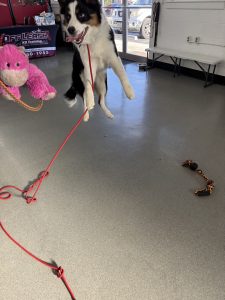
Step-by-Step: How to Stop a Dog From Jumping on Guests
Practice these exercises before expecting your dog to handle a busy gathering.
Step 1: Reward Four Paws on the Floor
Begin in a quiet room without visitors.
Stand near your dog and wait for all four paws to remain on the floor.
When that happens:
- Mark the behavior with a brief word such as “Yes,” if your dog understands the marker.
- Offer a small treat or calm praise.
- Pause before repeating.
- Reward the behavior again when it occurs naturally.
You do not need to require a sit. Standing calmly with four paws on the floor is also an appropriate greeting.
Avoid holding a treat above your dog’s head if that makes the dog jump to reach it.
As the exercise becomes easier, practice while you move around the room or approach your dog.
Step 2: Teach an Alternative Greeting Behavior
Choose one behavior your dog can perform comfortably when someone approaches.
Common options include:
- Sitting near you
- Standing with four paws on the floor
- Going to a designated mat
- Looking toward you when asked
Start with a behavior your dog already knows or teach it separately in a quiet setting.
For example, if you choose “Sit,” practice asking for a sit before offering attention.
Reward your dog while it remains seated. Then release it from the exercise.
If your dog stands up, that is not automatically a problem unless your greeting rule requires sitting. What matters is whether the dog can remain calm and avoid jumping.
Step 3: Practice With a Familiar Person
Ask a family member or trusted friend to help.
Begin before anyone approaches the front door.
- Keep your dog on a leash or behind an appropriate barrier.
- Ask the helper to stand several feet away.
- Reward your dog for keeping four paws on the floor.
- Have the helper take one step closer.
- Continue rewarding calm behavior.
- If your dog jumps or becomes too excited, have the helper pause or move farther away.
Practice at a distance where your dog can still respond comfortably.
Do not rush the helper toward your dog or repeatedly create situations in which jumping is likely.
The purpose is to teach your dog that calm behavior allows a greeting to continue.
Step 4: Practice a Doorway Greeting
Once your dog can remain calm as someone approaches, introduce the doorway.
Ask your helper to knock lightly or enter predictably.
Keep the first practice easy:
- Begin with the dog several feet from the entrance.
- Reward calm behavior before the helper comes inside.
- Have the helper enter quietly.
- Continue rewarding four paws on the floor.
- Allow a brief greeting only if your dog remains comfortable.
If your dog becomes overly excited, increase the distance from the doorway or return to an easier exercise.
You can also practice the sound of a doorbell separately before combining it with a visitor entering.
Step 5: Reward Calm Behavior During the Greeting
When your dog remains grounded, allow the helper to offer calm attention if your dog wants to interact.
If the dog jumps, the helper can briefly step away or stop interacting while you guide the situation safely.
As soon as your dog returns to an appropriate greeting behavior, reward it.
Do not wait until the entire greeting is over. Immediate feedback helps your dog understand which behavior earned the attention.
The American Kennel Club’s article on stopping jumping during greetings explains why rewarding the behavior you want is important.
Use the Place Command to Build Impulse Control
The Place command can be useful when guests arrive because it gives your dog a specific location to go to instead of rushing toward the door.
For this exercise, “Place” means moving to a designated spot, such as a suitable mat, bed, or platform, and remaining in position until released. Practice the specific position and release cue your dog has been taught.
Teach the behavior away from distractions first.
Practice Place Without Visitors
Start with a familiar mat or raised platform that is safe and comfortable for your dog.
Guide your dog onto the designated area using a method it understands.
Reward your dog for reaching the spot.
Gradually practice:
- Going to Place when asked.
- Remaining there briefly.
- Waiting while you take a small step away.
- Staying while you move around the room.
- Remaining in position until released.
Increase only one difficulty at a time.
If your dog repeatedly leaves the mat, shorten the exercise or return to an easier level.
Introduce Guest-Arrival Distractions
When Place is familiar, practice while a helper:
- Walks toward the door
- Knocks lightly
- Opens the door
- Steps inside
- Talks quietly
Keep your dog far enough from the activity to succeed.
Reward calm behavior and release your dog only when it is safe and appropriate.
A dog that cannot remain on Place while a visitor enters may need more practice with easier distractions. That does not mean the dog is being stubborn.
The goal is to build impulse control through manageable repetitions.
For a real example of Place and visitor-manners training, read how Hank worked on calmer greetings in Christiansburg, VA.
What to Do When Your Dog Jumps Anyway
Even with preparation, jumping may still happen.
Your response should focus on safety and helping your dog return to a behavior it understands.
Stay Calm and Avoid Physical Corrections
Avoid kneeing your dog in the chest, grabbing its paws, or pushing it away.
These reactions can cause discomfort or injury. Some dogs may also interpret physical interaction as attention or play.
Instead, calmly create space and pause the greeting.
If your dog is on a leash, use it to maintain a safe distance without jerking or dragging the dog.
Once your dog settles enough to respond, ask for an easy, familiar behavior and reward it.
Make the Next Attempt Easier
A failed greeting provides useful information.
Ask yourself:
- Was the visitor moving too quickly?
- Was my dog already excited before the door opened?
- Was the practice area too close to the entrance?
- Did someone pet my dog while it was jumping?
- Was the requested behavior too difficult?
Adjust the next practice session.
A dog that can sit quietly in the living room may not yet be ready to sit beside an open front door while several people enter.
Common Mistakes That Keep Dogs Jumping on Visitors
Allowing Jumping With Some People
If family members encourage jumping but guests discourage it, your dog receives mixed signals.
Decide on a consistent greeting rule and ask everyone to follow it.
This does not mean every greeting must look identical. Your dog can learn different cues for different situations, but that requires clear teaching.
Repeating Commands When the Dog Is Too Excited
Saying “Sit” repeatedly while your dog rushes toward a visitor is unlikely to help if the dog cannot respond at that moment.
Increase distance, reduce distractions, and practice the cue in easier situations.
Say the cue once when you reasonably expect your dog to respond.
Expecting Guests to Train the Dog
Visitors can support your plan, but you should manage the environment and guide the practice.
Some guests may be uncomfortable around dogs. Others may have limited mobility or be unable to follow the instructions.
Do not insist that anyone participate in a greeting exercise.
Greeting Too Soon
Your dog does not need to meet every visitor immediately.
If your dog is too excited to remain grounded, allow it to settle at a comfortable distance.
A successful visit can involve your dog resting behind a gate or in another room without greeting the guest.
How to Handle Jumping on Children and Older Guests
Jumping can be particularly dangerous when a dog greets small children, older adults, or anyone with limited balance.
Use management before opening the door.
For these visitors:
- Keep your dog securely separated until the environment is calm.
- Do not allow children to participate in training without close adult supervision.
- Avoid face-to-face greetings between dogs and children.
- Do not rely on a verbal command alone to prevent jumping.
- Allow visitors to decline interaction.
Never leave young children and dogs together without active adult supervision.
If your dog has a history of knocking people over, use a physical barrier rather than testing whether it will remain calm.
Safety takes priority over practicing a greeting.
What If Jumping Happens Along With Barking or Growling?
Jumping accompanied by barking, stiff posture, growling, snapping, or repeated attempts to retreat needs closer attention.
These behaviors may indicate fear, frustration, conflict, or another concern rather than friendly excitement alone.
Do not force your dog to interact with guests to “get used to them.”
Instead:
- Prevent direct access to visitors.
- Provide a quiet area where the dog can remain undisturbed.
- Watch for changes in body language.
- Avoid punishing warning signals such as growling.
- Seek individualized guidance when the behavior is persistent or creates a safety concern.
Our guide to dog body language and stress signals explains how posture, movement, and facial expressions can help you recognize possible discomfort.
If the behavior appears suddenly or is accompanied by signs of pain or illness, contact your veterinarian.
How Long Does It Take to Stop a Dog From Jumping on Guests?
There is no guaranteed timeline.
Progress depends on your dog’s learning history, excitement level, previous reinforcement, and how consistently you practice.
A dog may learn to keep four paws on the floor during quiet exercises but still struggle when unfamiliar visitors arrive.
Instead of setting a deadline, track practical improvements:
| Training stage | What progress may look like |
| Quiet room | Dog keeps four paws on the floor when you approach. |
| Familiar helper | Dog remains grounded while someone walks closer. |
| Doorway practice | Dog responds to a familiar cue before the helper enters. |
| Brief greeting | Dog receives attention without jumping. |
| Real visit | Dog remains safely managed and can settle despite visitors. |
Improvement is not always linear.
If your dog struggles after previously doing well, reduce the difficulty rather than assuming the training has stopped working.
Create a Simple Guest-Arrival Routine
Once your dog understands the foundation exercises, use a repeatable routine whenever visitors arrive.
Before the Door Opens
- Prepare rewards.
- Put your dog on a leash or behind a secure barrier if needed.
- Ask for a familiar behavior at a manageable distance.
- Remind visitors of your greeting rule.
As the Guest Enters
- Keep the arrival quiet.
- Reward your dog for remaining grounded or staying in Place.
- Prevent direct access if your dog becomes too excited.
- Allow the guest to settle before considering a greeting.
After the Guest Is Inside
- Continue rewarding calm behavior.
- Allow a brief greeting if your dog and guest are comfortable.
- End the interaction if your dog becomes overwhelmed.
- Provide a quiet resting option.
This routine connects greeting manners with the larger goal of impulse control: helping your dog respond to familiar expectations even when something exciting happens.
When to Seek Professional Dog Training
Consider professional help if your dog repeatedly jumps despite consistent practice, becomes difficult to manage around visitors, or struggles to respond to familiar cues when excited.
A trainer can help assess the dog’s current skills, household setup, and training goals.
If the behavior includes growling, snapping, or fear, explain that history clearly before scheduling training. Your dog may also benefit from veterinary or veterinary behavior assessment.
The New River and Roanoke Valleys training website lists obedience programs that address household manners, including greeting behavior and impulse control. Review the available dog training packages and pricing to understand the published options.
For help identifying a suitable program, contact the training team to discuss your dog’s age, behavior, and goals.
No program can guarantee that every dog will stop jumping in every situation. Continued practice at home remains important.
Frequently Asked Questions About Dogs Jumping on Guests
Why does my dog jump on guests but not on me?
Your dog may have learned different greeting habits with different people. Guests may be more exciting or may have rewarded jumping in the past. Practice with cooperative helpers to teach a consistent greeting rule.
Should I ignore my dog when it jumps on guests?
Briefly removing attention can help when jumping is driven by attention-seeking, but management and teaching an alternative behavior are also important. Do not simply ignore unsafe behavior while your dog continues jumping on someone.
Is it better to teach Sit or Place to stop jumping?
Either can help. Sit may be useful for a short greeting, while Place can help your dog remain away from the doorway during an arrival. Choose a behavior your dog can perform comfortably and teach it before adding visitors.
Can an older dog learn to stop jumping on people?
Yes. Adult dogs can learn new greeting habits. Dogs with a long history of successful jumping may need repeated practice and consistent responses from household members and visitors.
What should I do if my dog gets too excited when the doorbell rings?
Practice the doorbell sound separately at a low, manageable intensity. Reward calm behavior, then gradually pair the sound with simple doorway exercises. Use a gate, leash, or separate room during real arrivals until your dog is ready for harder practice.
Should every guest greet my dog?
No. Some visitors may prefer not to interact, and some dogs are more comfortable resting away from visitors. A calm, safely managed visit is a successful outcome even without a direct greeting.
Build Better Greeting Manners Through Consistent Practice
To stop your dog from jumping on guests, teach a calm greeting behavior, manage access to visitors, and reward four paws on the floor. Start with familiar helpers and gradually introduce more challenging arrivals as your dog improves.
If you need help with jumping, household manners, or obedience around distractions, review the available dog training programs and discuss your goals with the training team.